World’s First Offshore Ocean Heat Energy Platform Installed To Replace 25-GW Fossil Power
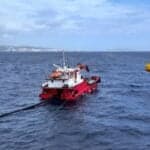


UK-based clean energy company Global OTEC has installed the world’s first purpose-built offshore platform designed to generate electricity using temperature differences in ocean water.
The company said the floating prototype has been deployed at the Oceanic Platform of the Canary Islands (PLOCAN), a marine testing site off the coast of Spain.
The project, called PLOTEC, is funded under a €3.5 million European Union Horizon Europe programme and is being developed by a consortium led by Global OTEC.
It marks the first time a system of this kind has been installed offshore to test continuous power generation from ocean thermal energy.
A key step in the installation was the deployment of a vertical seawater intake riser. This structure is used to bring cold water from deep below the sea surface and is considered one of the most difficult parts of building an offshore Ocean Thermal Energy Conversion (OTEC) system.
The floating setup allows engineers to test how the system performs in real ocean conditions, including how it behaves structurally and how it interacts with the marine environment.
The project has already gone through simulation and tank testing before moving to this offshore stage.
OTEC technology works by using the temperature difference between warm surface water and cold deep-sea water.
Warm water heats a working fluid with a low boiling point, creating vapour that turns a turbine to generate electricity.
Cold water, drawn from depths of up to around 3,280 feet, then cools the vapour back into liquid so the cycle continues.
Earlier versions of this technology were tested on land, where deep-sea water pipelines already exist.
However, those systems have limitations because long pipelines are expensive and make large-scale deployment difficult.
By moving the system offshore, the pipe length can be reduced by around 80%, which improves the possibility of scaling up.
Many island regions still depend on imported diesel and heavy fuel oil for electricity. This makes power generation vulnerable to fuel price changes and keeps electricity costs high.
While solar and wind energy are already being used, some locations face limits due to land availability and seabed conditions near the coast.
Global OTEC said its system could provide another option because it produces electricity continuously, unlike weather-dependent renewables.
The company estimates that more than 25 gigawatts of fossil fuel-based power capacity across tropical islands could eventually be replaced by OTEC systems.
Dan Grech, founder and CEO of Global OTEC, said the installation marks a shift from controlled testing environments to real ocean conditions.
He added that traditional onshore systems have been useful for testing and aquaculture, but offshore deployment allows a more scalable approach for power generation.
He also said that offshore OTEC systems could be developed in a modular way, making them more suitable for wider use, similar to how wind, solar and battery technologies have expanded over time.
With the Canary Islands installation now in place, the next step for the company is to deploy its first OTEC Power Module in Hawai’i.
That phase will focus on testing whether offshore systems can supply steady, round-the-clock electricity for island power grids at practical scale.
References: interestingengineering, energylivenews
Want to read more?
Check out the full article on the original site